
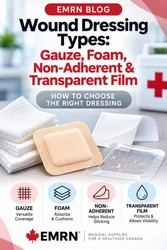
How to Choose the Right Wound Dressing: Gauze, Foam, Non-Adherent & Transparent Film
Posted by Mark M on 11th Nov 2026
Walk into almost any medical supply room and you may find dozens of different wound dressings.
Gauze pads, non-adherent dressings, bordered pads, foam dressings and transparent films can all look like variations of the same product—but their designs and intended functions can be very different.
Choosing between them starts with understanding what the dressing is supposed to accomplish: cover, absorb, protect, reduce sticking, manage drainage or allow the wound to remain visible.
This guide compares four common wound-dressing categories and explains the practical features healthcare professionals and purchasing teams should review.
Four Common Wound Dressing Types at a Glance
Why Gauze Remains a Wound-Care Staple
Gauze is one of the most familiar wound-care products and is available in a wide variety of forms, including sterile pads, non-sterile sponges, rolls and packing products.
Its versatility makes gauze useful across many medical environments, but the exact product matters. Size, ply, woven or non-woven construction, sterility and absorbency can all differ.
Choose a size appropriate for the area being covered.
Check the exact product configuration before use or ordering.
Pads, sponges, rolls and specialty gauze serve different purposes.
When Reducing Contact With the Wound Surface Matters
A non-adherent dressing is designed so the wound-contact layer is less likely to stick directly to the wound surface than traditional dry gauze.
Depending on the product, a non-adherent dressing may be a simple pad or part of a more complete bordered dressing system.
When comparing non-adherent dressings, check:
“Which dressing is best?”
It is “What does this dressing need to do?”
Designed for Absorption and Cushioning
Foam wound dressings are typically constructed from an absorbent foam material designed to manage wound exudate while maintaining coverage over the wound.
Some foam dressings include an adhesive border, while others are non-adhesive and require a separate method of fixation.
Products also vary considerably in thickness, absorbency, backing material and wound-contact technology.
Foam dressings are designed to absorb wound drainage.
The foam construction can provide additional physical cushioning.
Choose between bordered and non-bordered configurations where available.
Foams are available in different sizes and shapes for various applications.
Protection Without Hiding the Covered Area
Transparent film dressings use a thin, clear adhesive film that allows the covered site to remain visible.
Depending on the product and its indications, transparent film may be used for wound protection, as a secondary dressing or for securing and protecting certain device sites.
Transparent film provides visibility but is not the same as an absorbent foam dressing.
Dressing categories have different fluid-management capabilities. Review the manufacturer's indications and product specifications rather than substituting one category for another based only on size.
Comparing Common Wound Dressing Types
| Type | Key Feature | Absorption | Visibility |
|---|---|---|---|
| Gauze | Versatile basic coverage | Varies by product | No |
| Non-Adherent | Reduced sticking to wound surface | Varies by product | No |
| Foam | Exudate absorption and cushioning | Designed for absorption | No |
| Transparent Film | Thin transparent barrier | Limited unless combined with absorbent components | Yes |
Choose the Dressing Size as Carefully as the Dressing Type
Once the appropriate dressing category has been identified, the next step is choosing an appropriate size and configuration.
Manufacturers often offer the same dressing family in several dimensions. Some products can be cut, while others are designed to be used intact.
Check these details before ordering:
Similar-Looking Dressings May Have Very Different Features
Two dressings with similar dimensions may differ significantly in construction and intended use.
For example, one foam may have an adhesive border while another requires secondary fixation. One non-adherent pad may contain an absorbent layer while another primarily acts as a wound-contact layer.
Manufacturer product families such as 3M Tegaderm and Mölnlycke Mepilex also include multiple dressing technologies rather than one universal product.
8 Questions to Ask When Choosing a Wound Dressing
Common Wound-Dressing Purchasing Mistakes
Find wound dressings for your clinic, facility or healthcare organization.
EMRN supplies clinics, healthcare organizations, long-term care facilities, EMS teams, workplaces and businesses across Canada with gauze, dressings, bandages and advanced wound-care products.
Frequently Asked Questions About Wound Dressing Types
What are the main types of wound dressings?
Common categories include gauze, non-adherent dressings, foam dressings, transparent films and many more specialized wound-care products. Each category has different features and intended uses.
What is a foam wound dressing?
A foam wound dressing uses absorbent foam material to manage wound exudate while providing coverage and cushioning. Foam products may be adhesive, non-adhesive, bordered or non-bordered depending on the design.
What is a non-adherent dressing?
A non-adherent dressing is designed to reduce sticking between the wound surface and the wound-contact layer. Absorbency and construction vary by product.
What is a transparent film dressing?
Transparent film is a thin, clear adhesive dressing that can provide a protective barrier while allowing the covered area to remain visible. Specific indications vary by manufacturer and product.
Are all wound dressings sterile?
No. Wound-care products are available in both sterile and non-sterile configurations. Check the product packaging and specifications before ordering or use.
Where can I buy wound dressings in Canada?
EMRN supplies gauze, wound dressings, bandages and wound-care products for clinics, healthcare facilities, long-term care organizations, EMS teams, workplaces and businesses across Canada.
Gauze, foam, film or non-adherent? Start with what the dressing needs to do.
Explore EMRN's selection of wound-care products and medical supplies for healthcare organizations across Canada.
Explore Wound Care Supplies